EP33: Beyond Performance Reviews : What Drives Performance Today
Updated: Aug 13

Imagine you are a new manager at a fast-growing company. On your first week, HR hands you a stack of forms, walks you through the annual review cycle, and tells you the performance management process is all set up. You nod. You follow the steps. You fill in the rating boxes every December.
And yet, twelve months later, your best employee resigns. Another is quietly disengaged. A third has no idea what they are actually supposed to achieve.
Sound familiar? This is the paradox at the heart of performance management today. Most organizations have a process. Very few have a system that works.
👉The Uncomfortable Truth About Performance Management
Here is a number that should stop every HR leader in their tracks.
According to Deloitte's 2025 Global Human Capital Trends report, only 2% of Chief Human Resource Officers believe their current performance management system actually works.
Two percent. In a world where organizations invest enormous resources in HR technology, performance management software, and structured review cycles — the people closest to the system have almost no confidence in it.
And the trust problem runs even deeper. The same report found that 61% of managers and 72% of workers do not trust their organization's performance management process. When most of the people inside the system don't believe in it, the process becomes theater — something done to employees, not with them. So what is going wrong?
➡️ The Myth: Better Process = Better Performance
For decades, companies have treated performance management as an engineering problem. Build a better form. Tighten the rating scale. Add a mid-year review. Integrate an OKR platform. Automate the workflow.
The assumption is that if the process is clean enough, performance will follow.
But that assumption is crumbling.The real issue is not the form — it is what happens between the forms. It is the conversation that never happened. The feedback that arrived six months too late.
The manager who spent 87% of their time on operational tasks and only 13% actually developing their people. These are not process failures. They are human ones.
This is why the newest thinking in people analytics and HR transformation points away from process redesign and toward something more fundamental: the ecosystem of performance. And that ecosystem rests on three pillars.
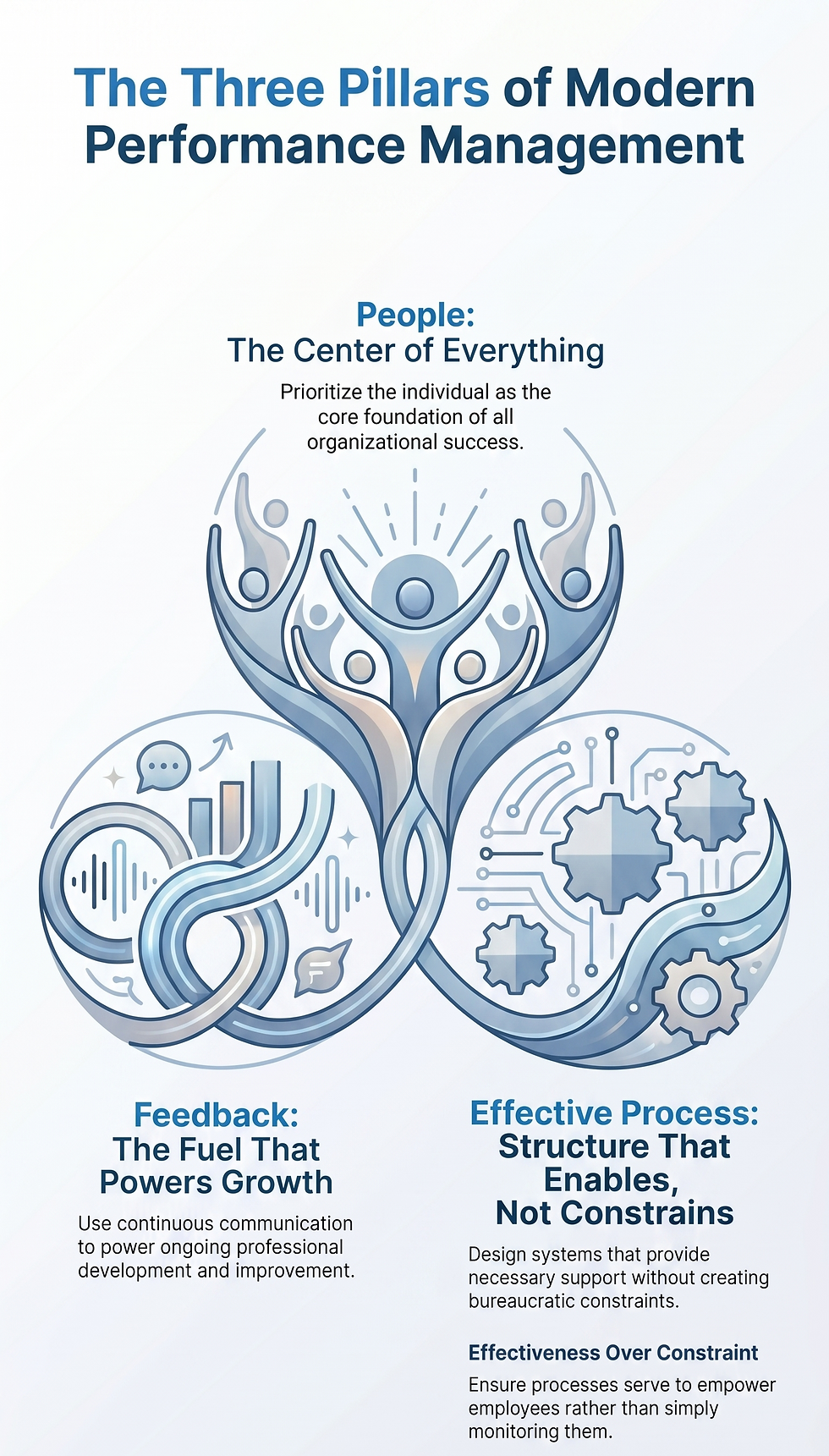
Pillar 1: People — The Center of Everything
Performance does not live in a spreadsheet. It lives in a person — their sense of purpose, their confidence in their goals, and their belief that what they do actually matters.
Yet a Gallup survey found that fewer than half of workers (47%) know what is expected of them at work. How can anyone perform well when they don't know what the target looks like?
Modern organizations are shifting toward a more employee-centered model of performance. Rather than evaluating people against a fixed framework at year-end, they are asking: What does this person need to do their best work — right now?
This shift is at the heart of what McKinsey calls "performance management that puts people first." Leading companies are moving from static competency models to dynamic, ongoing conversations. Some are even experimenting with team-based performance — setting goals at the team level, evaluating outcomes collectively, and linking individual compensation to shared milestones. It reflects a deeper truth: great performance is rarely a solo act.
★ The takeaway: A performance system that does not start with the human being at the center will always feel like a burden rather than a benefit.
2.Transparent Time-Off & Leave Management
Remove the guesswork from absence management. The ESS portal's My Time Off section gives employees real-time visibility into their leave entitlements — a core pillar of a mature workforce management software stack.
Check live Leave Balance instantly — reflecting Total Eligibility, Leaves Taken, and Pending Approvals
Submit requests for Annual Leave, Sick Leave, Compensatory Off, and Work From Home (Pre-Approval) directly
Receive instant status notifications so employees are never left waiting for updates
★ Gives employees scheduling autonomy while enforcing company policy automatically
3.Dynamic Approval Workflows for Managers (My Team)
Decentralisation works only when governance is airtight. entomo's HR analytics-backed Workflow Builder allows organisations to construct dynamic, multi-level approval flows based on department hierarchy, role, and business rules — eliminating the "request lost in an email" problem permanently.
My Team Availability — instantly see who is in, on leave, or working from home
Multi-level approvals and delegation rules configured without code
Auto-escalation when approval deadlines approach — keeping processes moving even during Peak Leave periods
Approve, reject, or delegate with a single click, with full Audit Trail for compliance
★ Accelerates decision-making and gives managers full team capacity visibility
4.Secure, On-Demand Financial Access (My Finance)
Payroll queries are both sensitive and urgent. Whether an employee needs documentation for a loan or a finance team needs to close month-end, delays are costly. The My Finance module — a core feature of entomo's enterprise HR software — resolves this entirely:
My Salary — view a full salary breakup: earnings, allowances, deductions, and taxes at any time
My Payslip — instantly retrieve, view, and download monthly statements as secure PDFs
Zero Payroll team intervention required for standard queries
★ Dramatically reduces Payroll workload, especially during month-end and when employees need urgent documentation
🌟Why This Matters for HR Transformation in Thailand
Organisations across Thailand are accelerating investment in HR digital transformation — driven by rising employee expectations, tightening labour markets, and board-level pressure to demonstrate People ROI. But technology alone is insufficient.
The organisations seeing the most impact are those that pair the right employee experience platform with a clear strategy for decentralising ownership of people operations. ESS is not a cost-reduction play. Done correctly, it is an employee engagement software strategy — one that signals trust, creates transparency, and removes daily friction from every employee's work life.
HR Leader's Perspective The most powerful outcome of an ESS platform isn't efficiency — it's culture. When employees can access their own data instantly, they feel trusted. When managers have real-time team visibility, they make better decisions. When HR isn't buried in admin, it becomes genuinely strategic. That's the transformation entomo enables.
Combined with entomo's broader capabilities — including performance management software, OKR software, continuous feedback, and AI-driven talent intelligence platform features — the ESS module becomes the operational foundation for a complete people experience platform that covers the full employee lifecycle.
💡CONCLUSION Conclusion: Elevating HR from Tactical to Strategic
A modern HR department should not be a helpdesk for administrative queries.
By implementing a robust, user-friendly Employee Self-Service system as part of a holistic HR software Thailand strategy, organisations eliminate operational bottlenecks, foster a culture of transparency, and reclaim thousands of hours annually.
The entomo platform — implemented by iCE Entomo, Thailand's authorised partner — enables precisely this shift. From the personal dashboard to on-demand payslips, from multi-level approval workflows to AI-driven manager insights, every capability is designed to return agency to your workforce and strategic capacity to your HR team.
Interested in transforming your PX with entomo!
Visit: www.iceentomo.co.th
Tel: 02-248-8168