
EP34: HR in 2030: 5 Transformative Trends Every Leader Must Prepare for Now
Updated: Aug 13

The way we manage people is undergoing its most important transformation in decades. What was once a function defined by paperwork, annual reviews, and reactive problem-solving is rapidly evolving into a strategic, data-driven engine at the heart of business growth. The future of work is no longer a distant concept — it is reshaping organizations right now, and the pressure on HR transformation has never been greater.
Leading consulting firms — Gartner, McKinsey, Deloitte, Mercer, and Josh Bersin — have converged on a striking conclusion: by 2030, the HR function as we know it will look fundamentally different. Not smaller in importance, but radically redesigned in how it works, what it prioritizes, and the tools it deploys.
For CHROs, HR Directors, and senior business leaders, the question is no longer whether to pursue HR digital transformation — it is how fast and how well.
Here are the five key trends shaping HR by 2030, and what they mean for your organization.
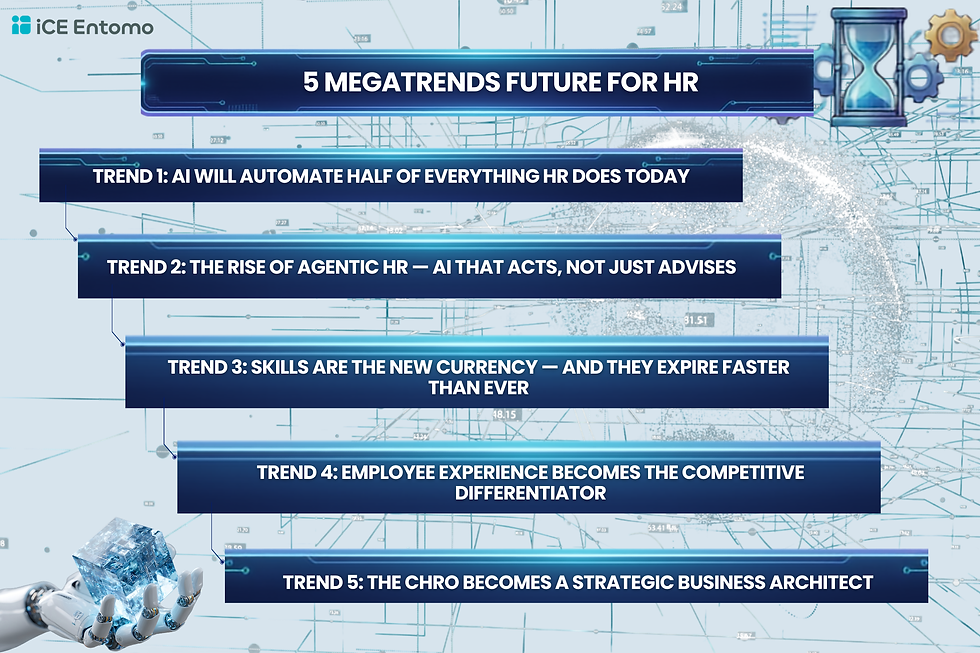
👉Trend 1: AI Will Automate Half of Everything HR Does Today
By 2030, AI will handle 50–60% of current HR tasks — queries, scheduling, performance tracking, compliance, reporting — and augment the rest. McKinsey adds a broader view: automation could lift global productivity 0.8–1.4% annually, reshaping over 30 million jobs a year, not eliminating them.
For HR leaders: HR isn't disappearing — it's being freed from admin work to focus on strategy: workforce planning, culture, org design, employee experience.
The risk is standing still. Gartner says redesigning the HR operating model offers the biggest AI productivity payoff (29%). Without proactive change, AI will shrink HR's role instead of elevating it.
The action: Map which HR tasks can be automated now, and start designing the operating model for what's next.
👉Trend 2: The Rise of Agentic HR — AI That Acts, Not Just Advises
Beyond automation, the next frontier is Agentic HR: AI that acts independently — sourcing candidates, redeploying talent, benchmarking pay, flagging performance risks, and personalizing development plans in real time.
Josh Bersin's HR 2030 Vision describes AI agents holding full employee data — skills, history, preferences, performance, career trajectory — to continuously optimize how people are managed and rewarded. HR Service Centers shrink, HR Business Partners become "Agent Managers" steering AI rather than processing requests, and CHROs become architects of AI-powered talent infrastructure.
For HR leaders:This isn't science fiction. As of early 2026, 82% of HR leaders plan to deploy agentic AI within 12 months, and 61% are in advanced gen-AI implementation — up from just 19% two years ago.
The action: Identify the highest-impact domains for agentic AI — talent acquisition, performance management, L&D — and start evaluating platforms built for this architecture
👉Trend 3: Skills Are the New Currency — And They Expire Faster Than Ever
By 2030, technical skills will have a half-life of just two years — meaning what employees know today may be partly outdated in 24 months. Upskilling must become continuous, not a one-off initiative.
Deloitte frames this a structural redesign challenge: organizations must shift from managing people by job title to managing them by skills and tasks — matching the right human or machine capability to the right work in real time. This is "talent intelligence" — using workforce data to decide who does what, the foundation of HR analytics in the AI era.
Mercer's Global Talent Trends 2026 (nearly 12,000 executives and HR leaders across 16 countries) adds that HR is under pressure to move beyond traditional operating models and play a more strategic role in shaping skills and effectiveness.
For HR leaders: Annual training calendars aren't enough. Learning must be embedded in the flow of work — personalized, continuous, tied to real business needs, and delivered through adaptive systems rather than static course libraries. Career development needs real-time competency data, not once-a-year conversations.
Gartner also warns that 1 in 5 employees will need redeployment by 2030 as jobs shift — and most organizations aren't ready for that internal mobility challenge.
The action: Invest in people analytics for real-time visibility into workforce skills. Build adaptive — not static — L&D and career development systems.
👉Trend 4: Employee Experience Becomes the Competitive Differentiator
The talent landscape is quietly fracturing. About 36% of employees in Europe and the US are dissatisfied with their employer — and nearly 20% are unhappy but have no plans to leave, a sign of silent engagement breakdown.
Mercer names EVP recalibration as a defining HR priority for 2026+. Employees, especially newer ones, expect different things from technology, transparent performance decisions, and authentic leadership.
Deloitte's 2026 Global Human Capital Trends report says the organizations that thrive will "lead with a human edge" — pairing AI efficiency with human empathy, judgment, and creativity.
For HR leaders: Employee experience is no longer a soft metric — it's a core business outcome that affects productivity, retention, and resilience. HR leaders who build personalized, data-informed, consistent journeys from onboarding through career growth will gain real advantage. This is especially urgent in Thailand and ASEAN, where talent expectations are rising faster than most HR functions can keep up.
The action: Audit your employee experience touchpoints. Find where data is fragmented, feedback loops are broken, and the experience falls short of your talent brand promise.
👉Trend 5: The CHRO Becomes a Strategic Business Architect
Across the research, one theme is consistent: the CHRO is shifting from people manager to business architect. The title stays the same — the mandate expands dramatically.
Gartner's 2026 CHRO Priority research (426 CHROs, 23 industries, 4 regions) identifies four imperatives:
Harness AI to Revolutionize HR — build an HR-focused AI strategy, evolve the operating model, redesign performance and talent management for the AI era.
Shape Work in the Human-Machine Era — develop a "now-next" talent strategy for a blended human-AI workforce, grounded in workforce planning and competency frameworks.
Mobilize Leaders for Growth in an Uncertain World — equip leaders to routinize change, not just inspire it. Organizations that do this are 3x more likely to achieve healthy change adoption.
Build Future-Ready HR Teams — upskill HR talent while meeting new demands, investing in HR and people analytics.
Josh Bersin adds: CHROs who succeed by 2030 will manage legacy systems and build Agentic HR architecture at the same time — navigating both worlds while keeping people and performance central.
For HR leaders:
HR's credibility now depends on linking people's strategy directly to business outcomes. Leaders need fluency in AI governance, workforce economics, data ethics, and org design — not just traditional HR skills. Talent intelligence platforms and HR analytics are becoming as essential as core HR competency.
The action: Define what your HR function needs to look like by 2030 — what capabilities, what technology, what kind of team in skills, structure, and mindset.
🌟What This Means for Organizations in Thailand and Southeast Asia
The trends described above are global, but their implications are particularly acute for organizations in Thailand and the broader ASEAN region. Companies here face a dual challenge: the urgency of HR digital transformation and the reality of talent markets that are rapidly evolving in expectations and complexity.
HR leaders in this region who move quickly to build digital infrastructure — integrating AI-powered performance management, continuous employee engagement and feedback systems, people analytics dashboards, talent intelligence platforms, and competency-based upskilling programs — will be disproportionately rewarded. The HR tech Thailand ecosystem is maturing fast, and the gap between early movers and those who wait is widening every quarter.
Those who wait will find themselves competing for talent against organizations that have already made employee experience and workforce planning a strategic differentiator.
The future of HR is not coming. It is here. The organizations that act now will define the standard for others to follow.
Interested in transforming your PX with entomo!
Visit: www.iceentomo.co.th
Tel: 02-248-8168

